Fall 2026 Course AI Rules: What Students Need to Check
A DormWay analysis of 12,920 candidate syllabus transcripts, corrected using a random source-review sample, examines permission for AI across course tasks.

A DormWay analysis of 12,920 candidate syllabus transcripts, corrected using a random source-review sample, examines permission for AI across course tasks.
A student can be allowed to use AI on an exam in one course and prohibited from using it to brainstorm in another. Before using a familiar tool, the student needs to identify the rule for the particular assignment, the stage of work and any approval or disclosure requirement.
DormWay organizes syllabus deadlines, schedules and course policies. We examined AI rules because understanding course requirements is part of organizing a semester. This is a study of documents in our filtered collection, not a national survey or a measurement of student confusion.
The findings
| Written rule | Estimated share of eligible, policy-evaluable transcripts | 95% sampling interval |
|---|---|---|
| Contains an operative AI-use policy | 75.3% | 73.2–77.4% |
| Default prohibition with exceptions or task-limited permission | 33.9% | 31.1–36.6% |
| Assessed-work prohibition without an operative assessed-work exception | 23.3% | 21.1–25.5% |
| Mixed or unclear permission regime | 11.7% | 9.2–14.2% |
The measures overlap and are not slices of one pie. Private study can be allowed even where AI is prohibited for assessed work. The mixed/unclear category includes incomplete or ambiguous scope; it is not a contradiction or student-confusion rate. A missing rule does not establish permission.
The same tool, different tasks
Official public Fall 2026 sources make the distinctions concrete. These are separate illustrations, not additions to our statistical denominator.
Brainstorming and editing. TAMIU’s ENGL 3307 prohibits AI throughout its creative-writing process, including preparation and feedback. COMM 3332 encourages AI-assisted ideas, draft copy and imagery with attribution and verification while excluding quizzes and direct pasting of AI-generated body copy.
Two TAMIU courses, side by side
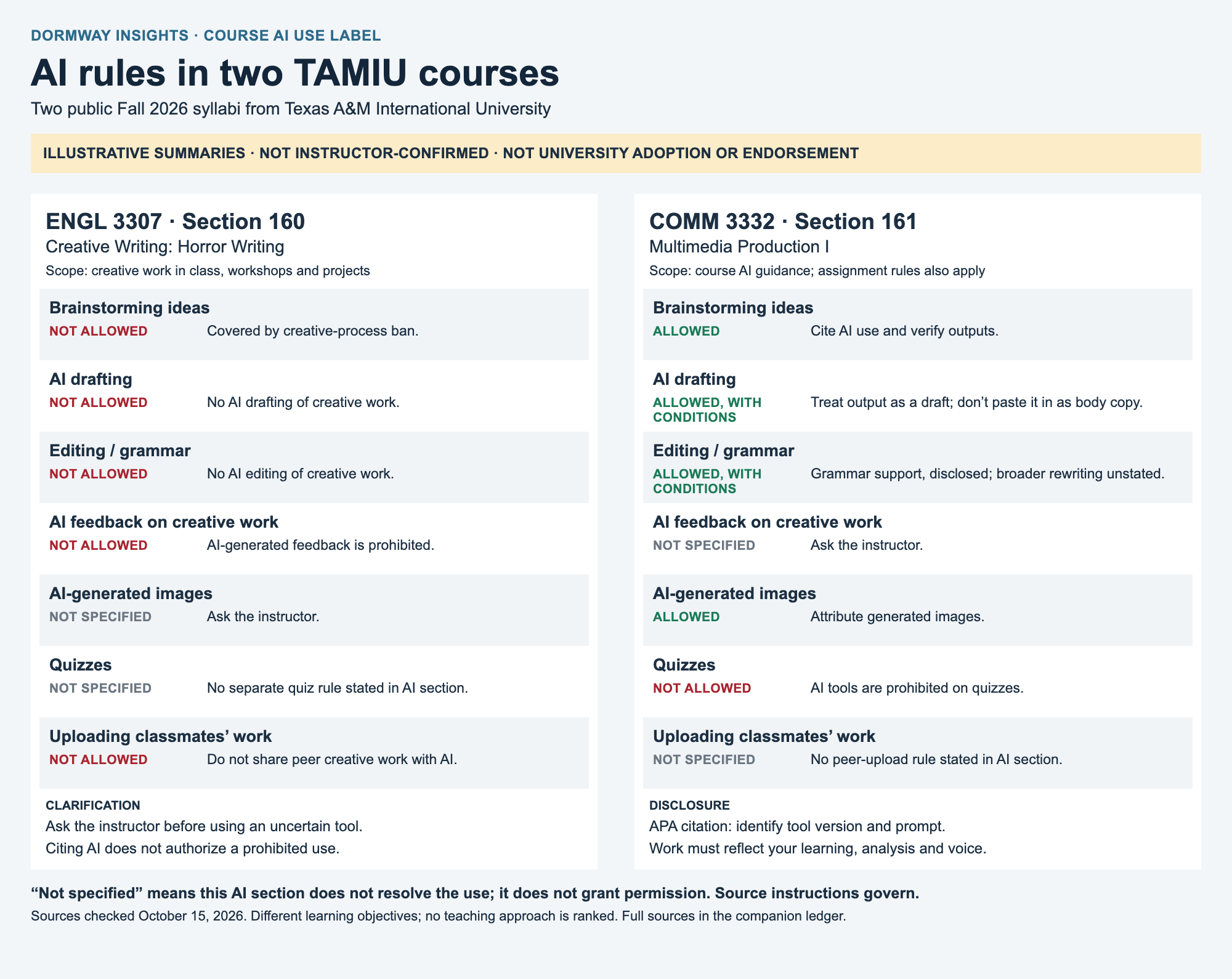
These are DormWay summaries of the public Fall 2026 AI sections, not instructor-confirmed labels or evidence of university adoption. ENGL 3307’s prohibition covers its creative-writing process; it is not presented as a blanket ban on every possible use. COMM 3332’s permissions carry attribution, verification and original-contribution conditions. “Not specified” does not grant permission. Different learning objectives can justify different rules.
| Activity | ENGL 3307: creative-writing scope | COMM 3332: stated AI guidance |
|---|---|---|
| Brainstorming ideas | Not allowed | Allowed with attribution and verification |
| AI drafting | Not allowed for creative work | Allowed, with conditions: treat output as a draft; no directly pasted generated body copy |
| Editing / grammar | No AI editing of creative work | Allowed, with conditions: grammar support with disclosure; broader rewriting not specified |
| AI feedback on creative work | Not allowed | Not specified in AI section |
| Generated images | Not specified in AI section | Allowed with attribution |
| Quizzes | No separate quiz rule in AI section | AI tools prohibited |
| Uploading classmates’ work | Peer creative work must not be shared with AI | No peer-upload rule in AI section |
Sources: ENGL 3307, Artificial Intelligence Policy and COMM 3332, Academic Integrity and AI Use, checked October 15, 2026. The course examples are separate illustrations; their membership in the study’s statistical frame is not established.
Programming and exams. UT Austin’s CS 380I, page 5, permits programming assistance with individual understanding and exam use with disclosure of tools and affected questions. CS 439 requires explicit written permission for generated code or text solutions.
Exceptions and broader warnings. UT Austin’s CS 109 contains conditional authorization alongside general integrity restrictions. Specific permission can reasonably be an exception, but the reader must establish how those sections apply together.
Different assessments can have good reasons for different rules. These comparisons do not rank teaching approaches or show that one student took all these courses.
What changes for the student
The practical work is identifying permission before acting. Citation does not override a ban. Disclosure after use does not satisfy a requirement for advance approval. A permitted project workflow does not automatically extend to an exam, and permission to use a tool does not necessarily permit uploading instructor or peer material.
The stated academic consequences can be substantial. TAMIU’s ACC 4370 states course failure and Honor Council referral for breach of its AI restrictions. Our study did not count actual penalties or measure student grades.
The seven-question checklist helps students check task permission, approval, independent work, disclosure, assessment conditions, uploads and conflicting instructions. The original course instructions and instructor clarification remain the authority.
Why this matters beyond college
LinkedIn’s 2026 report reports 70% year-over-year growth in US jobs requiring AI literacy. Growth in observed requirements is not the percentage of all jobs. It does help explain why students need deliberate opportunities to practice responsible AI use alongside independent assessments.
Universities are also making course-level expectations more explicit. USC announced on October 6 that syllabi must describe AI rules beginning in Spring 2027 while leaving substantive decisions to faculty. Our research note links the announcement and the other primary sources.
DormWay’s position is that students should be able to determine which rule governs before using a tool. Course policies should identify permitted preparation, editing and assessment uses; approval and documentation requirements; and how specific exceptions relate to broader restrictions.
The Course AI Use Label
DormWay now shows a Course AI Use Label: a consistent summary of task-level permissions, conditions and source instructions. Its purpose is to help students locate the relevant rule while preserving instructors’ decisions about learning and assessment. The label is available in the DormWay app. It is not an adopted institutional standard, and its effectiveness has not been tested.
The label records Allowed, Limited, Approval required, Not allowed, or Required for each activity, with the conditions beside the status. It separately covers private study, brainstorming, editing, coding assistance, generated text and images, quizzes and exams. It also identifies disclosure requirements, approved tools, upload restrictions, access costs or alternatives, governing sources, the instructor and the effective date. Blank or unresolved entries stay Not specified—ask the instructor; silence does not grant permission. Where documents differ, the instructor must identify the governing instruction rather than the label silently choosing a rule.
Download the template and read the completion guide. Instructors can use the same layout in a syllabus and for assignment-specific exceptions. In the DormWay app, the label is an automated summary of the course’s syllabus until the instructor confirms it; the original instructions govern.
Existing work includes the AI Assessment Scale and Mercer’s traffic-light guidance. This independently written template provides a task-by-task communication format and does not reproduce their diagrams or level definitions. No institutional endorsement or partnership is implied. We invite feedback at press@dormway.app before piloting whether students can identify the correct permission and conditions more reliably.
How this was checked
All 12,920 candidate transcripts received automated screening. A preselected random sample retained all 600 selections, yielding 540 eligible, policy-evaluable reference cases. Estimates correct automated outputs using the sample’s observed classification and source-eligibility errors.
Policy detection agreed with the agent-reviewed reference in 531/540 cases (98.3%); exact category agreement was 437/540 (80.9%). The study was not independently human-coded or externally peer reviewed. Original files were retrieved for a separate 600-record fidelity audit; one omitted policy prompted a sensitivity analysis with essentially unchanged prevalence.
The frame includes international courses and different transcriptions of the same file. It is not a count of unique courses or a representative sample of US institutions. Read the research note for full dispositions, intervals, correction methods and limitations.
Data and reuse
The accompanying aggregate tables and public-source ledger support checking the findings. No private syllabus uploads or student-linked records are included. Please cite DormWay’s Fall 2026 course AI-policy study, source snapshot October 14, 2026, and keep the eligible-transcript denominator with any percentage.
This study is a separate edition from earlier DormWay AI-policy analyses. Its cohort, term screen and codebook differ; the figures should not be read as a time trend.
About DormWay
DormWay is a student planner that organizes syllabus deadlines, schedules and course policies. Its core organization tools are free. Explore DormWay.
Sources & Methodology
About Riley
Founder & CEO
Riley made DormWay to solve his own problems, and in the process is solving all college students'. A fourth-year at U-M with 100K+ followers across platforms, Riley taught himself to code while building DormWay.